 Search
















Description
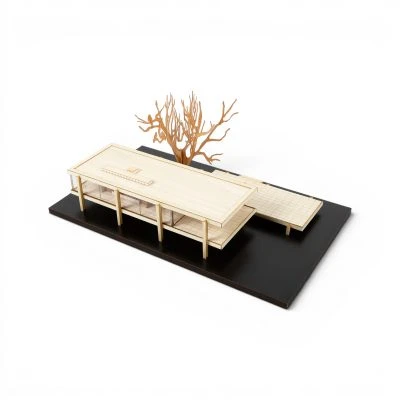
A ready-to-assemble architectural model kit of Ludwig Mies van der Rohe’s Farnsworth House in Plano, Illinois, one of the clearest and most influential expressions of modernist residential architecture.
Conceived in 1945 and completed in 1951, the house was commissioned by Dr. Edith Farnsworth as a weekend retreat along the Fox River. Mies reduced the idea of the home to its essentials: two horizontal planes, a white steel frame, floor-to-ceiling glass, an open interior, and a close visual relationship with the surrounding landscape. The result is a house that appears to hover above the ground, light in form yet rigorous in proportion.
From an architectural standpoint, the Farnsworth House is a landmark of the International Style. Its radical simplicity, transparent glass enclosure, and open plan helped define the language of mid-century modern architecture. Rather than separating domestic life from nature, Mies created a structure that frames the landscape from every side, turning the house into both a shelter and an architectural lens.
The building’s influence extends far beyond its modest scale. It became a reference point for glass-and-steel modernism, minimalist residential design, and the idea of architecture as an exact composition of structure, proportion, and space. Listed on the National Register of Historic Places in 2004 and designated a National Historic Landmark in 2006, the Farnsworth House remains one of Mies van der Rohe’s most studied and debated works.
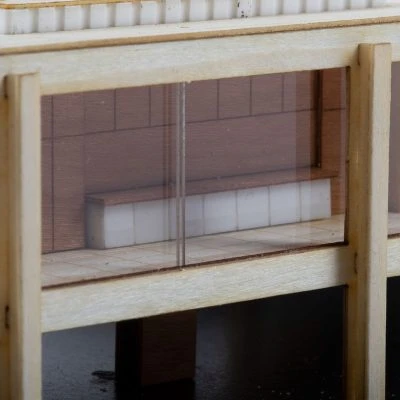
Made by Little Building Co., this 1:150 scale wooden architectural model kit recreates the house’s floating planes, raised terrace, slender supports, glass volume, and surrounding site. The kit is crafted from Aspen, American Cherry, Black Maple, MDF, and acrylic, and includes the Black Maple tree that once grew on the Farnsworth House property.
The kit includes clear, stage-by-stage assembly diagrams. Glue is required and not supplied; Little Building Co. recommends a good-quality PVA wood glue, which dries clear and allows time to carefully reposition parts during assembly.











Reviews